
Local
LIGHTS OUT: Junee businesses revolt over streetlight shutdown

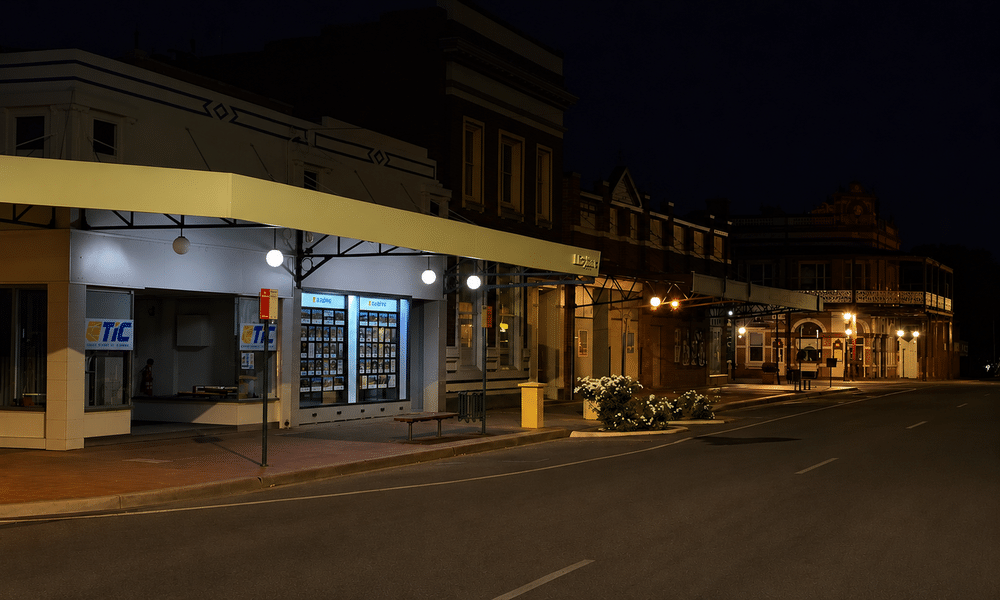
DOZENS of streetlights illuminating Junee’s historic shopping precinct face being switched off in January, sparking backlash from local business owners who have been told they must foot the bill if they want to keep their under-awning lights operating.
The controversial move follows a decision by Junee Shire Council to support Essential Energy in relinquishing responsibility for 49 ageing under-awning lights, many of which have illuminated the town’s public footpaths for decades.
Affected business and property owners were formally notified in a letter from Council dated October 29, advising that their existing lights would be disconnected from Essential Energy’s unmetered streetlighting network no earlier than December 31, 2026.
The electricity distributor has proposed January 18, 2027, as the disconnection date.
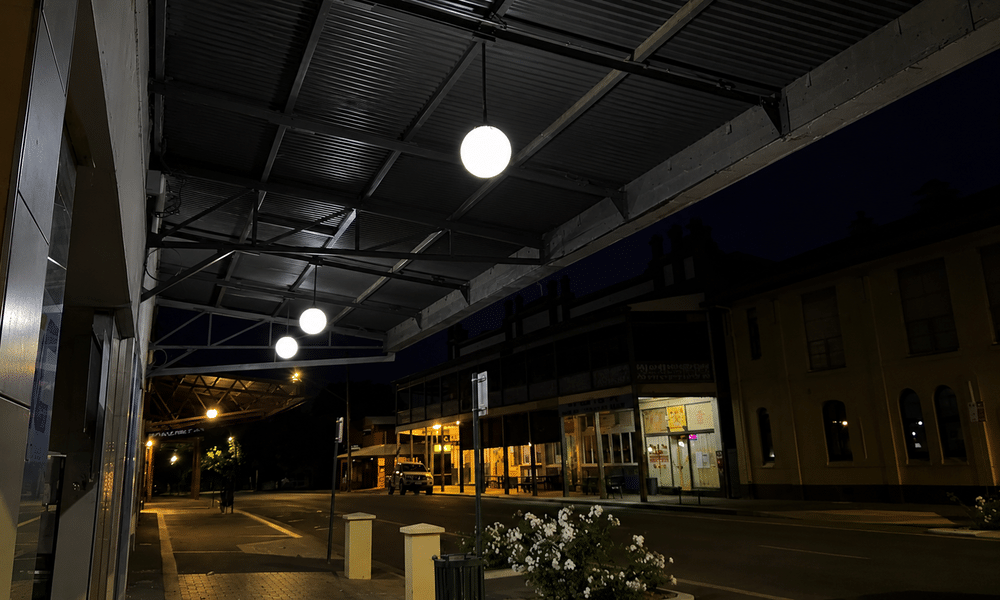
The globe-style light fittings suspended beneath Junee’s shop awnings in Lorne Street are non-compliant with new standards | © The Junee Bulletin
Businesses wishing to retain their existing lighting have been told they must engage a qualified electrical contractor, at their own expense, to rewire the fittings into their premises’ metered electricity supply.
The work must be undertaken by a suitably accredited electrical service provider in conjunction with Essential Energy before the proposed January 18 disconnection date, otherwise they could face additional connection requirements, potentially complicating and increasing the cost of retaining the infrastructure.
Owners have also been encouraged to consider replacing existing fittings with LED alternatives or other lighting technologies.
The proposed shutdown has sparked growing concerns among local traders about public safety, the financial burden on small businesses and the potential impact on Junee’s historic streetscape.
Those concerns have now reached Member for Cootamundra Steph Cooke, who is calling on Essential Energy to work with Council and affected businesses to find a practical solution before the disconnections proceed.
“Junee’s CBD needs to remain safely lit, and I share the concerns of local businesses about the cost of these changes,” Ms Cooke told the Junee Bulletin.
“I’m asking Essential Energy to work with Junee Shire Council and affected businesses on a practical, fair solution before disconnections proceed.
“Small businesses should not be left to shoulder the financial burden.”
Decision made in March
Council documents reveal the decision to transfer the lights was formally adopted at Junee Shire Council’s ordinary meeting on March 17, more than seven months before affected businesses received their notification letters.
The motion, moved by Councillor Robin Asmus and seconded by Councillor Pam Halliburton, endorsed a four-point recommendation from Council’s engineering department.
Under the resolution, Council agreed not to accept ownership of the affected lighting assets, except where it was the adjoining landholder.
Instead, it endorsed supporting Essential Energy in returning the assets to the appropriate adjoining landholders and providing alternative public lighting where required, within its existing operating budget.

The decision followed discussions between Council and Essential Energy over changes to the NSW Public Lighting Code and the future of ageing, non-standard lighting infrastructure.
According to the report presented to councillors, 49 under-awning lights were identified across five circuits associated with the Junee Hotel, JJ Glass & Co, Commonwealth Bank, Commercial Hotel and Memorial Park.
Many of the fittings are attached to privately owned buildings, with some awnings reportedly damaged or in poor condition.
Essential Energy advised Council that it could no longer continue to own and maintain the infrastructure under its existing public lighting arrangements.
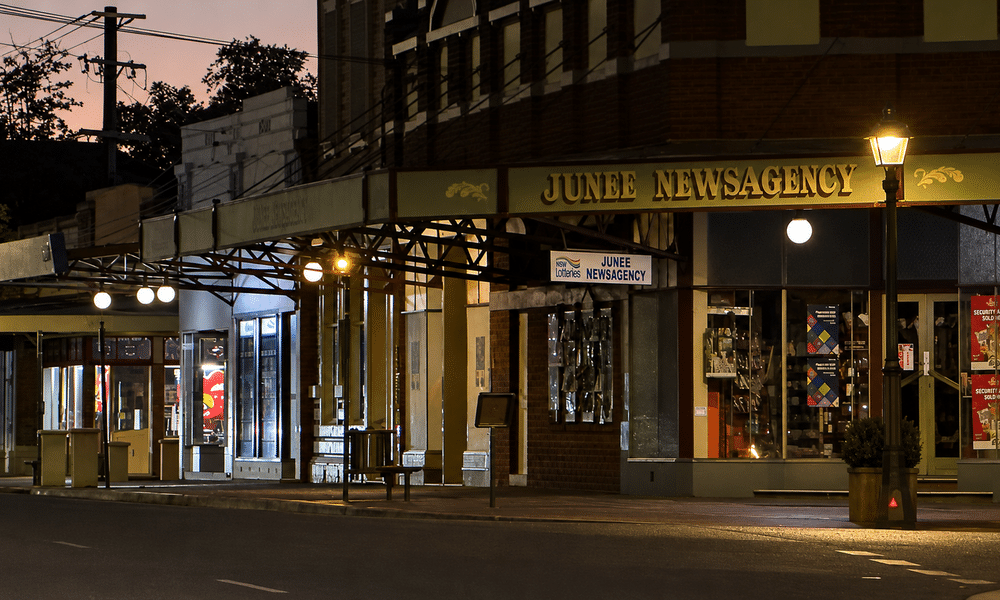
Existing under-awning lights illuminate the Junee Newsagency frontage and neighbouring businesses | © The Junee Bulletin
In correspondence dated March 3, Essential Energy explained that ongoing maintenance costs exceeded the tariffs being charged to Council and that no approved standard replacement was available for the existing fittings.
The distributor also indicated that many of the lights were approaching or had reached the end of their economic life.
Council subsequently considered three options: upgrading the existing lights, assuming ownership of the infrastructure, or supporting their transfer to adjoining property owners.
Upgrading the lights was deemed impractical in the short term, with the March report identifying significant design, electrical and structural challenges.
“This is not something that is achievable in the near future for either Essential Energy or Council,” the report stated.
“This would require new light designs followed by major electrical modifications to premises that are not in the care or control of either Council or Essential Energy. Rectification of damaged assets would also be required.”

Council also ruled out assuming ownership of the non-compliant infrastructure, citing safety risks and concerns about existing electrical connections.
“Taking on non-compliant assets is a significant risk for Council,” the report stated.
“Given the quality of electrical connections in many of these structures, Council staff considered this option not to be feasible.”
The preferred approach was to support Essential Energy in transferring responsibility for the lights to adjoining property owners.
“Their location beneath private awnings suggests they are more appropriately aligned with the adjoining businesses rather than the public road network,” the report stated.
“Council should assist to facilitate this and should not take on the risk of these assets.”
$100,000 estimated for alternative lighting
Despite declining ownership of the existing infrastructure, Council acknowledged its continuing responsibility to ensure adequate lighting across its public roads and footpaths.
The March report identified an estimated $100,000 in additional expenditure over two years ($50,000 annually) to assess lighting requirements and install alternative public lighting where necessary.
“This funding will be allocated to reviewing and installing adequate public lighting on Council’s network in these areas and ensuring the lighting is isolated from the building structure,” the report stated.
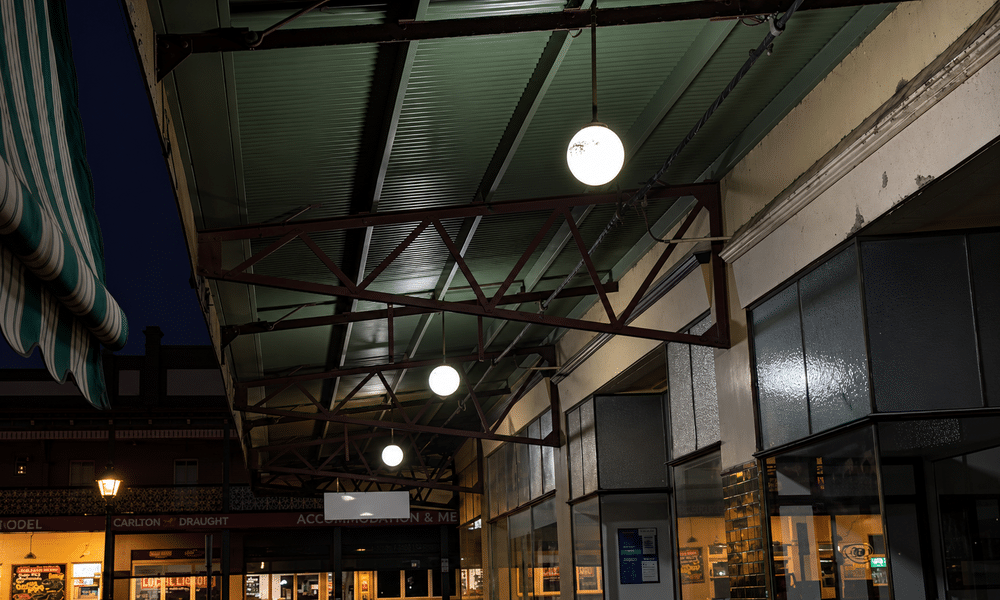
The existing under-awning lighting infrastructure has served Junee’s shopping precinct for decades | © The Junee Bulletin
While Council has committed to providing alternative public lighting where required, it remains unclear which locations will receive replacement infrastructure, whether the new lighting will adequately illuminate covered pedestrian walkways, or if the necessary works will be completed before the existing lights are disconnected in January.
The distinction between relinquishing ownership of the existing fittings and maintaining suitable public lighting is now central to the growing dispute.
Public safety concerns
Despite Council’s commitment to maintaining adequate public lighting, the decision has sparked mounting criticism from local traders, who question why they should be expected to shoulder the costs of infrastructure that illuminates public spaces.
Junee TSG owner Marney Wishart is spearheading opposition to the move, accusing authorities of attempting to shift public infrastructure responsibilities onto private landholders.
“We want a safe community for all residents and I do not believe that the responsibility of providing safe public lighting should be placed on local business owners and operators,” Ms Wishart said.
“We are doing it tough as it is without adding this additional burden,” she said, warning that multiple businesses are struggling to simply keep their doors open.
With the existing lights scheduled for disconnection in less than three months, concerns are also mounting over whether adequate replacement lighting will be installed in time.
While Council has committed to providing alternative lighting where required, questions remain about how effectively it will illuminate covered pedestrian walkways, particularly outside normal business hours.
Advertisement
Ms Wishart has questioned why Council and Essential Energy cannot reach an alternative arrangement that preserves adequate public lighting without imposing additional financial burdens on traders.
“Why is Junee Shire Council trying to pass the buck to private property owners for public streetscape safety?” she asked.
“Why aren’t they negotiating a funded, heritage-compliant solution with Essential Energy like other shires do?”
Ms Wishart has pointed to Bathurst Regional Council’s handling of similar lighting issues, arguing that Junee should explore a more collaborative approach involving alternative infrastructure and financial support.
Essential Energy’s March correspondence confirms the distributor was open to providing funding assistance for design development and considering suitable replacement options.
However, it remains unclear whether any such assistance has been secured for Junee.
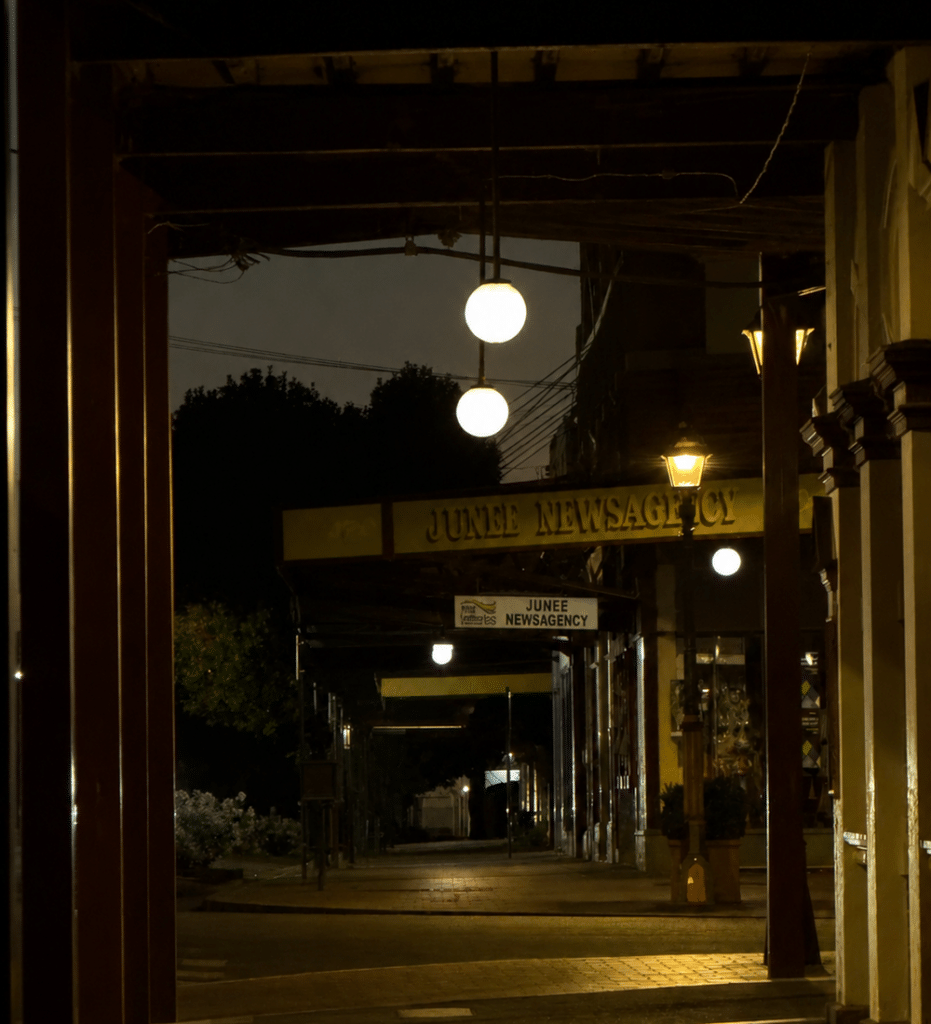
The globe-style streetlights hang beneath the awning of the historic Loftus Hotel on the corner of Lorne and Humphrys streets | © The Junee Bulletin
The proposed changes have also raised concerns about preserving Junee’s historic streetscape, with much of the town’s traditional shopping precinct situated within a designated Heritage Conservation Area.
Ms Wishart argues the existing under-awning lights contribute to the town’s heritage character and that any electrical modifications or replacement fittings must take heritage requirements into account.
She has urged affected business and property owners to unite against the decision and called on Council to undertake further negotiations with Essential Energy.
The local businesswoman has already raised the matter with Member for Cootamundra Steph Cooke, and intends to escalate her concerns to the NSW Ombudsman and the Energy and Water Ombudsman NSW.
Affected business and property owners wishing to discuss the issue or join the push for a resolution can contact Ms Wishart at junee@tsg2u.com.au.











LIGHTS OUT: Junee businesses revolt over streetlight shutdown

Christmas on Broadway returns with free rides for kids

‘We’re not attacking Council’: Chocolate factory responds to $19K fine


